Built to Rank - Smart Website Architecture That Drives Leads for Service Businesses
Built to Rank - Smart Website Architecture That Drives Leads for Service Businesses
For service businesses, rankings are not won by keywords alone. They are earned through structure. Smart site architecture is the backbone of SEO performance, user experience, and conversion flow. When a website is built with clear hierarchy, logical navigation, and intentional internal linking, search engines understand it faster and customers trust it sooner.
At Tactical Boost Digital, site architecture is treated like mission planning. Every page has a role, every section supports the objective, and nothing exists without purpose. This disciplined approach is what allows service-based businesses to rank consistently in competitive local markets.
Why Site Architecture Is a Ranking Factor, Not Just a Design Choice
Search engines crawl websites the same way users experience them - from the top down, following links and structure. When a site is disorganized, bloated, or flat, authority gets diluted and important pages struggle to rank.
Strong architecture helps by:
• Clearly defining service priorities
• Distributing authority through internal links
• Improving crawl efficiency and indexing
• Reducing bounce rates and confusion
For service businesses, architecture determines whether Google sees you as a generalist or an authority in specific services and locations.
The Core Structure Every Service Business Website Needs
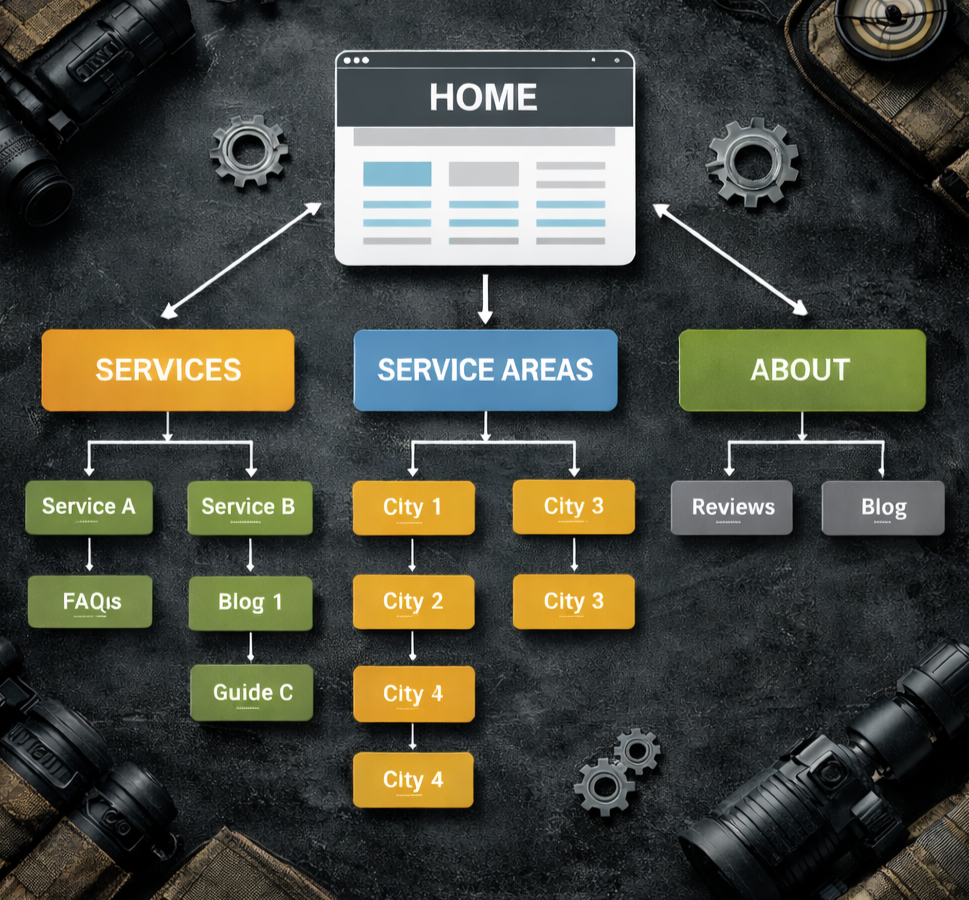
A high-performing service website follows a clear hierarchy. This is not about aesthetics. It is about control and clarity.
A proven structure looks like:
• Homepage as the authority hub
• Primary service category pages
• Individual service detail pages
• Location or service area pages where appropriate
• Supporting content like FAQs and resources
Each layer reinforces the one above it. This structure allows search engines to understand what you do, where you do it, and which pages deserve priority.
Homepage as the Command Center
The homepage is not a dumping ground. It is the command center that funnels authority to key pages.
A properly structured homepage:
• Links intentionally to primary service pages
• Establishes topical relevance immediately
• Reinforces brand credibility and trust signals
• Guides users toward clear next actions
When the homepage is overloaded with unrelated content or generic messaging, it weakens the entire site.
Service Pages Built for Depth, Not Duplication
One of the most common mistakes service businesses make is combining multiple services onto one page or duplicating shallow pages with swapped keywords.
Smart architecture separates services cleanly.
Each service page should:
• Focus on one core service
• Answer real customer questions
• Link back to its parent service category
• Support conversion with clear calls to action
This structure allows each service to rank independently while strengthening the overall site.
Location Pages That Actually Rank
For businesses serving multiple areas, location pages are critical. But they only work when they are part of a clean architecture.
Effective location pages:
• Sit under relevant service pages
• Are linked logically through navigation or hubs
• Provide unique, useful local context
• Avoid thin or duplicated content
When location pages are isolated or mass-produced, they fail. When they are integrated strategically, they dominate local results.
Internal Linking as a Tactical Weapon
Internal links are not decoration. They are how authority moves.
A disciplined internal linking strategy:
• Pushes authority from high-traffic pages to revenue pages
• Reinforces topical relationships
• Improves crawl paths for search engines
• Keeps users engaged longer
Random linking wastes power. Intentional linking compounds it.
Navigation That Serves Users and Search Engines
Navigation should never be built solely for looks. It should reflect the site hierarchy exactly.
Effective navigation:
• Mirrors service categories
• Avoids clutter and unnecessary depth
• Makes important pages accessible within two to three clicks
• Adapts cleanly for mobile users
When navigation matches architecture, everything becomes easier to rank and easier to use.
Why Flat Websites Fail Service Businesses
Many service websites are built flat, with all pages linked equally and no hierarchy. This makes it impossible for search engines to determine importance.
Flat sites suffer from:
• Weak topical authority
• Confused crawl signals
• Poor internal link flow
• Lower conversion rates
Hierarchy creates order. Order creates rankings.
How Smart Architecture Improves Conversions
Ranking is only half the mission. Structure also controls how visitors move.
Well-architected sites:
• Guide users logically toward contact points
• Reduce decision fatigue
• Build trust through clarity
• Increase form submissions and calls
When users do not have to think, they convert.
What a Tactical Boost Site Architecture Build Looks Like
A strategic site architecture project includes:
• Business and service analysis
• Keyword and intent mapping
• Page hierarchy planning
• Navigation and internal link design
• Conversion flow alignment
Nothing is accidental. Everything is planned.
Why Service Businesses Choose Tactical Boost Digital
Tactical Boost Digital brings a disciplined, veteran-owned approach to SEO and site architecture.
Clients choose Tactical Boost because:
• Structure is built before content
• SEO and UX are aligned from day one
• No bloated pages or wasted assets
• Every page has a clear mission
This is not about chasing trends. It is about building systems that rank and convert long term.
Build a Website That Is Engineered to Rank
If your website feels scattered, underperforms in search, or struggles to convert traffic into leads, architecture is likely the problem. A smart structure can unlock rankings you have been missing.
Contact Tactical Boost Digital to build a site architecture that is clear, scalable, and built to dominate search results for service businesses.
Ready to work with Tactical Boost?
Let's connect! We’re here to help.
Send us a message and we’ll be in touch.
Or give us a call today at 725-240-0304
REQUEST A NO COST BRIEF:
More Marketing Tips, Tricks & Tools