
What Is Local SEO?
Search engine optimization (SEO) is the work of helping your business show up when people search for what you offer. Local SEO is the version that matters to service businesses: showing up when someone nearby searches for the exact job you do, whether that's "water heater replacement," "roof repair near me" or "veteran-owned contractor."
More visibility means more of the right traffic. More of the right traffic means more leads. But rankings are only the means. The point is the phone call, the form, the booked estimate.
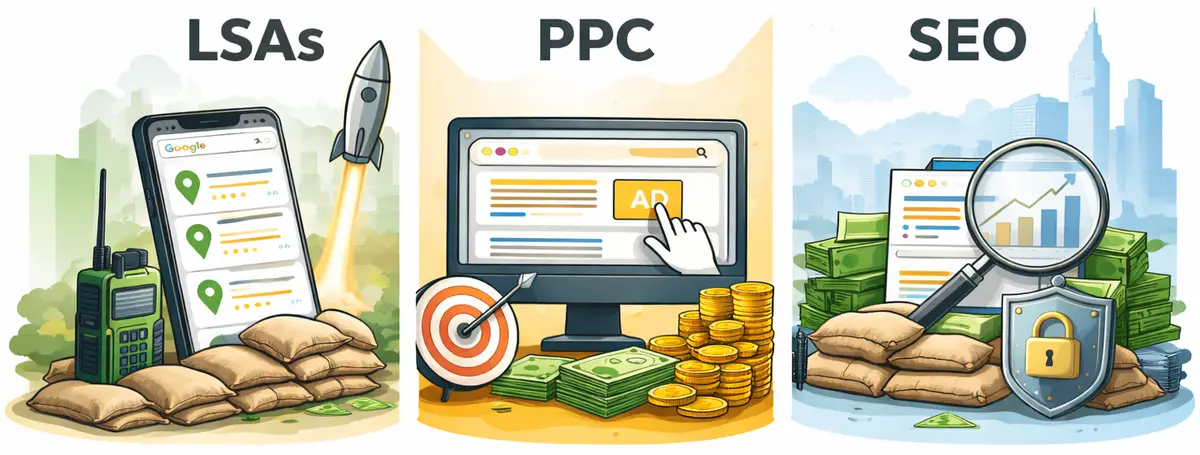
Local SEO for a service business has two fronts that work together. Your Google Business Profile fights for the Map Pack, the three businesses shown on the map. Your website fights for the organic results underneath. Win both and you own the page.
Why SEO Matters for Service Businesses
Your future customers are already searching. The only question is whether they find you or your competitor.
Search engines are where buying decisions start. Whether someone is looking for a contractor, an electrician or an HVAC company, they aren't flipping through a phone book. They're typing into Google, and more and more often, asking an AI assistant.
- If your business isn't showing up, you're invisible.
- If you're buried on page two, you're irrelevant.
- If you're not properly optimized, you're leaving money on the table.
SEO is not about collecting clicks or impressions. It's about getting in front of people who are ready to call and buy. Done right, it becomes your top-performing sales channel. Always working. Always compounding. You stop renting attention by the click and start owning ground.
The Three Things Google Checks Before It Ranks You
Strip away the jargon and Google is asking three questions about every page it might show.
1. Visibility: can Google find and understand your site?
Fast-loading pages win. Your site should work smoothly on a phone, run on HTTPS, keep a clean sitemap and avoid blocking Google's crawlers. The right pages should be indexed, and junk pages should not. If Google can't crawl it, nothing else on this page matters. Our plain-English guide to Core Web Vitals covers speed in detail.
2. Relevance: are you speaking your customers' language?
Figure out what your customers actually search for and use those words naturally. Every page should have one clear purpose: one goal, one topic. Headings should organize the message, and internal links should connect related pages so people and crawlers can explore. Refresh anything outdated.
3. Authority: does Google trust you over the competition?
Earn links from trusted, relevant sites, never from link farms. Publish content that teaches, explains and solves problems instead of only selling. Add schema markup so search engines can read your business details, and show proof of expertise: bios, experience and credentials where they count.
How to Run Local SEO Yourself, In Order
Order matters. Most wasted SEO budgets come from doing step six before step two. Run these in sequence.
- Map your money. List the services you most want to sell and the towns you can reach in a normal workday. That list becomes your page plan and your keyword map. If a service isn't on the list, it doesn't get a page yet.
- Fix the foundation. Connect Google Search Console, submit a sitemap, and fix anything blocking crawling or indexing. Check that your site loads quickly on a phone and runs on HTTPS.
- Give every service its own page. One service, one page, one job. A page that tries to rank for furnace repair, AC installation and duct cleaning at once ranks for none of them. Our guide to service pages that rank and convert walks through the structure.
- Answer the buyer's question first. Put what you do, where you do it and how to book in the first lines of the page. Then back it up with process, proof, pricing guidance and FAQs.
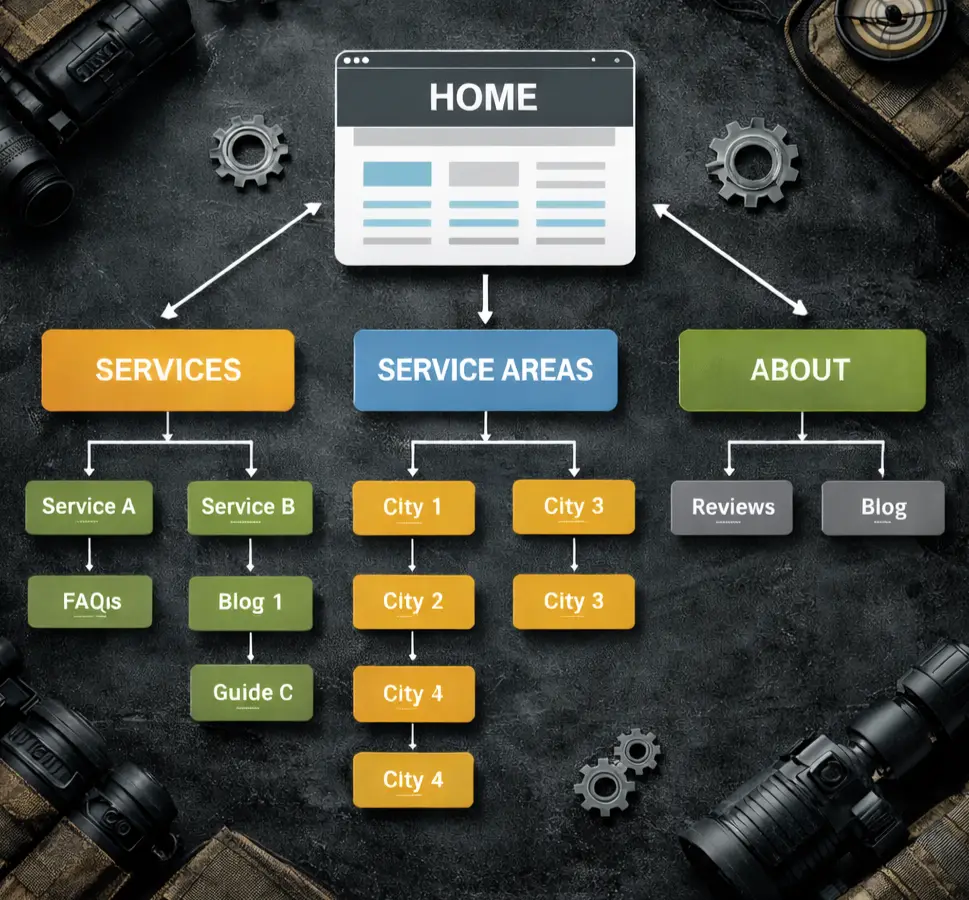
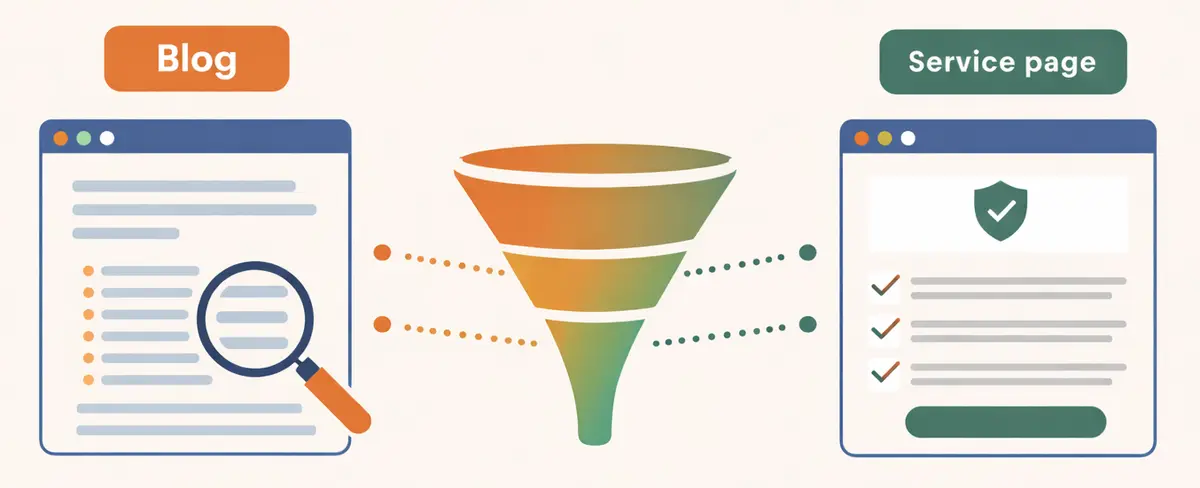
- Connect the pages. Link from your homepage to every core service, from service pages to the towns you serve, and from every blog post to the service it supports. See smart site architecture for the full pattern.
- Earn local authority. Build a steady review habit, keep your name, address and phone identical everywhere, and earn local links that aren't sketchy from sponsorships, associations and partners.
- Measure what rings. Track calls, forms and booked jobs by page and by source. Rankings are a leading indicator. Revenue is the scoreboard. Our GA4 guide for owners shows the three reports to watch.
Want the expanded version with checklists for each phase? That's the SEO Boot Camp.
How SEO Turns Clicks Into Customers
Getting someone to your site is only half the battle. What happens next is what really counts.
Good SEO doesn't just put eyes on your brand. It creates a clear, trustworthy path from first click to final contact. When a potential customer lands on your site, they should instantly know they're in the right place and what to do next.
That means structuring content to speak directly to the searcher's intent, designing every page to build trust and remove confusion, and leading people to real action: calling you, booking a service or sending a request. No noise. No fluff. Just a site that closes the gap between you and your next customer.
What It Actually Takes: Time, Tools and Timeline
You don't need expensive software to start. The core toolkit is free: Google Search Console, Google Analytics 4, your Google Business Profile and Bing Webmaster Tools. What it does take is consistency.
- Time: a few focused hours every week, every week. A steady cadence beats a big push followed by silence.
- People: someone who can edit pages, someone who can take photos on the job, and someone who owns the review habit. On a small crew that might be the same person.
- Timeline: technical fixes can show up within weeks. Rankings for competitive services usually take months, because you're earning trust, not flipping a switch. Be suspicious of anyone who promises page one in 30 days.
If those hours don't exist on your calendar, that's the honest reason to hire help. Not because SEO is mysterious, but because it's relentless.
Where SEO Ends and GEO Begins
Buyers are now asking ChatGPT, Gemini and Google's AI Overviews who to hire. The good news: the work above is the foundation for that, too. Google says its AI features are rooted in its core ranking and quality systems.
The difference is that AI answers punish muddy pages harder. An AI system needs one clean answer it can lift and cite, so a page with a scattered purpose loses the mention even if it ranks. That discipline is called generative engine optimization. Our GEO field guide picks up where this page leaves off.
Built on Discipline. Powered by Strategy.
As a veteran-owned agency, we bring the same values that shaped our service careers to every engagement: order, discipline, clarity and execution. Our mission is clear: deliver real results without the runaround.
- No bloated packages.
- No buzzwords.
- No drawn-out timelines.
Just clear strategy, honest communication and execution that moves the needle. We don't waste your time. We make the most of it.